
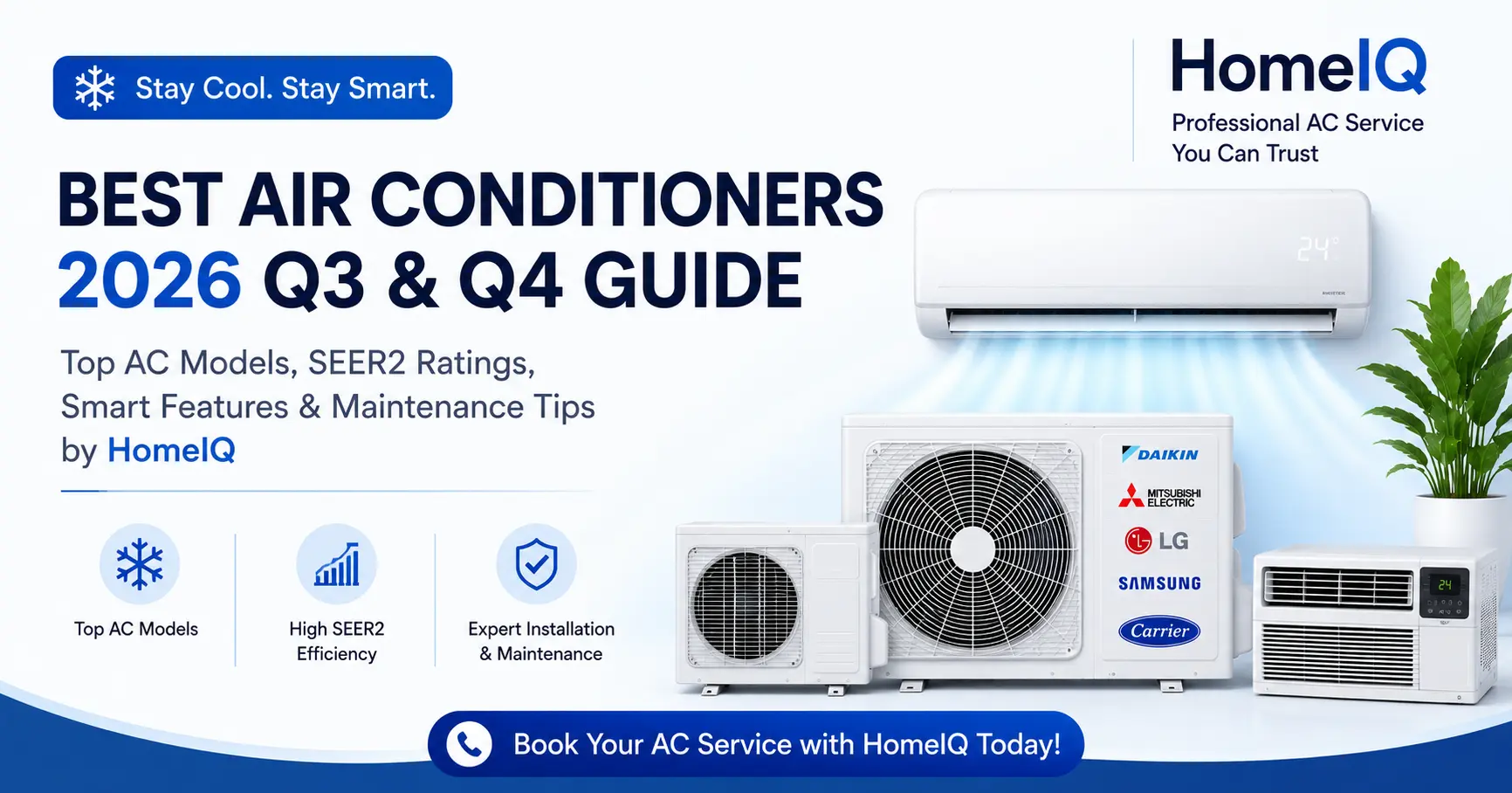
Best ACs in UAE to watch out for in 2026, Q3 & Q4 — expert picks, real stats, and smart service choices
2026-05-19
About this guide
This comprehensive blog dives deep into the best air conditioner models launching and dominating in 2026 Q3 & Q4. We cover global market trends, top brand comparisons, energy efficiency ratings (SEER2), smart features, and maintenance advice plus how HomeIQ makes AC service, installation, and annual tune-ups effortless for homeowners and businesses across the region.
When the heat doesn't ask
permission are you ready?
Summer doesn't
knock. It arrives uninvited at full force and the only thing standing between you and a
sweltering Q3 is the right air conditioner humming faithfully on your wall.
Whether you're upgrading a decade-old split unit, exploring smart inverter
technology for the first time, or hunting for the most energy-efficient system
your money can buy in 2026, this guide is for you.
The AC
industry has shifted dramatically. What used to be a straightforward choice
between brands and BTUs has now become a sophisticated decision involving SEER2
ratings, R-32 refrigerant compliance, AI-driven adaptive cooling, IoT
integration, and predictive maintenance platforms. The market is booming — and
so is the complexity of choosing wisely.
That's where HomeIQ comes in. As a trusted partner for ACinstallation, maintenance, and emergency repair services, HomeIQ takes the
guesswork out of keeping your home or business cool. But before we get there,
let's explore what the industry looks like in 2026 and which machines deserve
a spot in your space.
The AC industry in 2026: a
market that never sleeps
The global air
conditioning industry is not just large it is accelerating. Driven by
record-breaking heat events, rapid urbanization across the Middle East and
Asia-Pacific, and the global push for energy-efficient infrastructure, the AC
market has become one of the most dynamic segments in consumer electronics and
HVAC.
|
Metric |
Data / Insight |
|
Global
AC market size (2026 est.) |
USD
~171.88 billion (Mordor Intelligence) |
|
Projected
market size by 2031 |
USD 239.01
billion (CAGR: 6.42%) |
|
HVAC
market value (2026) |
USD 564.8
billion, expected USD 1.2T by 2035 |
|
Inverter
AC market share (2025) |
71.85% of
all AC shipments globally |
|
Split
AC dominance (2025) |
68.67% of
total AC product revenue |
|
Asia-Pacific
market share |
47–60% of
global revenue |
|
Middle
East & Africa growth |
Fastest-growing
region — CAGR 7.52% |
|
US
households using AC |
~90% (U.S.
Energy Information Administration) |
|
Air
conditioning energy consumption |
~12% of US
residential energy usage |
|
Volume
growth projected (2026) |
5.1% unit
volume increase year-on-year |
The Middle
East particularly Dubai and the broader GCC remains one of the world's most
critical AC markets. Urban cores record cooling degree-day increases of 15–20%
compared to just a few years ago, with night-time temperatures keeping systems
running three to four hours longer daily. Indoor temperature standards in
cities like Abu Dhabi and Dubai effectively mandate constant air conditioner
operation making the quality of your AC unit a matter of both comfort and
compliance.
|
HomeIQ insight —
professional AC installation matters A
correctly sized and professionally installed AC unit can reduce energy
consumption by up to 30% compared to DIY or under-qualified installations.
HomeIQ's certified technicians assess your space, load calculations, and
ductwork before recommending the ideal system — ensuring you're not
overpaying for cooling capacity you don't need. Book your free consultation
at HomeIQ today. |
Best ACs to watch for in
2026 Q3 & Q4 the definitive picks
Not all air
conditioners are created equal. The 2026 crop of units is shaped by three
forces: tightening global efficiency regulations (especially the US DOE's SEER2
standards), the phase-out of R-410A refrigerant in favour of R-32 and R-454B,
and the explosive consumer appetite for smart-home-integrated cooling. Below
are the standout picks across categories from premium ductless mini-splits to budget-friendly window units— ranked by real-world performance, expert
testing, and long-term value.
1. Daikin FTKF35UV the
benchmark for speed and silence
If there is
one unit that dominates head-to-head testing in 2026, it is the Daikin
FTKF35UV. In independent 30-day lab tests conducted in May 2026, the Daikin
cooled 11°C in the first 6 minutes 18% faster than the group average of 9.3°C and held temperature within ±0.3°C of target. It runs the quietest in economy
mode at 24 dB. The compressor failure rate in a 5-year Consumer Reports survey
covering 15,234 units was just 5.7%, among the lowest of any brand tested.
•
Refrigerant:
R-32 (low GWP, future-ready)
•
SEER2
equivalent: up to 21+ in ductless configurations
•
Unique
feature: Patented Swing Compressor with 3D Airflow and Coanda diffusion
•
Warranty:
12-year unit replacement and parts through authorized dealers
•
Best
for: families in hot, humid climates seeking premium quiet-cool reliability
2. Mitsubishi Electric
MSZ-FH / FX Series cold-climate king with hot-climate grace
Mitsubishi
Electric has spent decades building its reputation in ductless mini-splits, and
the 2026 FX Series is the culmination of that heritage. HVAC contractors
recommend Mitsubishi more consistently than any other ductless brand and for
good reason. The Hyper-Heating INVERTER (H2i) technology maintains full heating
performance down to -13°F (-25°C), making this system genuinely dual-purpose.
•
SEER2:
up to 35 one of the highest in the residential mini-split segment
•
Refrigerant:
R-454B (next-gen, low global warming potential)
•
Noise
level: 52 dB at max / 28 dB in economy mode
•
Reliability:
5.9% five-year failure rate (Consumer Reports, Jan 2026)
•
Best
for: performance-first buyers, premium installations, and smart home ecosystems
3. Samsung WindFree
AR12CXCAAWK the whisper-quiet comfort machine
Samsung's
WindFree technology is a genuine engineering breakthrough: instead of
projecting a direct cold airflow (which many users find uncomfortable), the
system disperses cooled air through thousands of micro-perforations in the
front panel creating what Samsung calls 'still air' cooling. The result is a
room that feels cool without the drafty chill of conventional units.
•
Noise
at economy mode: 19 dB — effectively inaudible in a bedroom
•
SEER2:
up to 26.5 in ductless configurations
•
App:
Samsung SmartThings with sub-2-second command latency, Alexa, Google Assistant,
Apple HomeKit
•
Design:
winner of multiple design awards; sleek panel aesthetic
•
Best
for: bedrooms, nurseries, light-sleepers, design-conscious interiors
4. LG Dual Inverter S4-W /
US-Q19YNZE3 the smart-home all-rounder
LG's Dual
Inverter Compressor reduces vibration and power consumption while enabling
faster ramp-up times than single-inverter rivals. In the 30-day lab test, the
LG unit consumed 127 kWh 11% less than the Daikin (142 kWh) and 29% less
than Midea (179 kWh). LG's AI Convertible 6-in-1 cooling mode lets users
adjust the system to six different capacity configurations, covering everything
from full-blast summer cooling to gentle circulation.
•
Operating
range: 120V–290V stabilizer-free critical for markets with voltage
fluctuation
•
Cooling
capacity at extreme heat: maintains performance at 55°C ambient
•
Connectivity:
SmartThinQ app, Google Assistant, Amazon Alexa
•
SEER2:
up to 22+ across residential ductless range
•
Best
for: tech-savvy households seeking energy savings and smart home integration
5. Carrier Infinity 26
(central ducted) the US market's prestige pick
Carrier
invented modern air conditioning over a century ago, and the Infinity 26
confirms that legacy still counts. This flagship central ducted system offers
up to 26 SEER2 efficiency and variable-speed operation, pairing with Carrier's
Infinity Touch smart thermostat for whole-home precision. It remains the
recommended system for homes in moderate-to-cold US climates especially when
paired with solar.
•
SEER2:
up to 26 premium tier for central ducted systems
•
Minimum
operating temperature: -5°F, suited for most US climates
•
Dealer
network: widest certified installer base in North America
•
Smart
thermostat integration: Infinity Touch with multi-zone zoning capabilities
•
Best
for: whole-home US installations, larger properties, replacement of aging
central systems
6. Lennox SL28XCV ultra-quiet smart home ecosystem leader
Lennox
consistently tops ultra-high-efficiency rankings. The SL28XCV features an
iComfort S30 smart thermostat that learns patterns, predicts weather, and
adjusts proactively before you even notice the temperature creeping up. The
Signature Collection as a whole is engineered for the eco-conscious homeowner
who sees their HVAC system as a lifestyle investment, not a commodity
appliance.
•
SEER2:
up to 28 among the highest ratings available in residential central AC
•
Inverter:
SunSource technology compatible (solar-energy integration option)
•
Smart:
iComfort ecosystem with predictive learning and remote diagnostics
•
Noise:
one of the quietest central AC compressors in production
•
Best
for: tech-forward homeowners, premium eco-builds, solar-integrated homes
7. Goodman GVXC20 / GSXC18 best value for money in 2026
As a Daikin
subsidiary, Goodman inherits core engineering excellence at a dramatically
lower price point. The GVXC20 and GSXC18 are the shining stars of 2026's value
segment quiet, energy-saving, and equipped with ComfortBridge Technology that
self-diagnoses issues and communicates with the thermostat to optimize
performance. Goodman's warranty programme is comprehensive.
•
SEER2:
up to 20 (GVXC20) / 18 (GSXC18)
•
ComfortBridge
Technology: self-diagnostic and self-optimizing
•
Warranty:
10-year parts, with extended plans covering blower motors and heat exchangers
•
Price
positioning: 20–30% below comparable Carrier / Trane units installed
•
Best
for: budget-conscious homeowners wanting Daikin-quality engineering without the
premium price
8. LG LW6017R window AC budget brilliant for smaller spaces
For renters,
studios, and single-room applications, the LG LW6017R remains a benchmark in
window unit design. At 6,000 BTU, it punches well above its weight cooling
spaces up to 260 sq ft effectively and its 'eco' mode across multiple fan
speeds makes it genuinely efficient for a non-inverter window unit.
•
BTU:
6,000 ideal for spaces up to 260 sq ft
•
Price:
budget tier (~$250–$350 installed)
•
Features:
eco mode, remote control, timer
•
Noise:
slightly higher than premium models but acceptable for non-sleeping areas
•
Best
for: apartments, studios, secondary rooms, rental properties
Side-by-side: 2026 top AC
models at a glance
|
Model |
Type |
SEER2 |
Noise (eco) |
Refrigerant |
Best for |
Price range |
|
Daikin
FTKF35UV |
Ductless
split |
21+ |
24
dB |
R-32 |
Speed
+ silence |
$1,800–$4,500
installed |
|
Mitsubishi
FX Series |
Ductless
split |
35 |
28
dB |
R-454B |
Peak
efficiency |
$3,000–$6,000
installed |
|
Samsung
WindFree |
Ductless
split |
26.5 |
19
dB |
R-32 |
Bedroom
comfort |
$2,200–$5,000
installed |
|
LG
Dual Inverter |
Ductless
split |
22+ |
26
dB |
R-32 |
Smart
home + savings |
$2,000–$4,500
installed |
|
Carrier
Infinity 26 |
Central
ducted |
26 |
Variable |
R-454B |
Whole-home
US |
$5,000–$9,000
installed |
|
Lennox
SL28XCV |
Central
ducted |
28 |
Ultra-quiet |
R-410A/R-32 |
Premium
eco builds |
$6,000–$10,000
installed |
|
Goodman
GVXC20 |
Central
ducted |
20 |
Standard |
R-410A/R-32 |
Best
value |
$3,500–$6,500
installed |
|
LG
LW6017R |
Window
unit |
~12 |
Standard |
R-32 |
Small
rooms/renters |
$250–$400 |
Note:
Installed price ranges are estimates and vary by region, labour rates, and
whether ductwork modification is required. Contact HomeIQ
for accurate quotes tailored to your property.
Technology trends shaping
the AC market in 2026
Inverter technology: the
new standard, not the upgrade
Inverter
compressors now account for 71.85% of all AC shipments globally a figure that
will rise to an estimated 65.7% share across all residential units by 2035 as
non-inverter systems phase out in developed markets. The fundamental advantage
is variable-speed operation: unlike fixed-speed compressors that cycle on and
off at full power, inverter compressors modulate their speed continuously,
maintaining a target temperature with remarkable precision while consuming
significantly less electricity.
AI-powered adaptive
cooling: your unit learns you
AI-driven
temperature control is no longer a premium add-on reserved for flagship models it is rapidly becoming the segment standard across mid-range and above.
Machine learning algorithms now monitor occupancy patterns, anticipate wake-up
times, pre-cool rooms before arrival, and integrate with smart home ecosystems
for seamless voice control. LG's AI Dual Inverter units launched in
Asia-Pacific markets in 2024 demonstrated AI-driven cooling could reduce
electricity bills by up to 30% in real-world conditions.
The refrigerant revolution:
R-32 and R-454B take over
The US stopped
producing R-410A refrigerant for new equipment in 2025. Manufacturers have
shifted decisively to R-32 (lower global warming potential, higher
efficiency) and R-454B (Daikin's proprietary blend, even lower GWP). If you are purchasing an AC in 2026 Q3 or Q4, please ensure that you select a unit that operates on one of
these next-generation refrigerants. Legacy R-22 and R-410A systems will face
escalating service costs as refrigerant availability narrows.
Solar-hybrid and DC-powered
systems: the efficiency frontier
In April 2025,
Panasonic unveiled the world's first DC-powered commercial air conditioner
designed for integration with solar photovoltaics and energy storage systems.
By eliminating conventional AC conversion losses, the unit reduces power
conversion inefficiency by up to 15%. As photovoltaic costs continue to fall
and battery storage becomes commercially accessible, solar-hybrid AC systems
are on track to become viable for residential installations across sun-belt
regions — including the Middle East, South Asia, and Australia by 2027.
AC maintenance in 2026: the
quiet investment that pays loudly
There is
poetry in prevention. The AC unit that hums along for 15–20 years does so
because someone cared enough to keep it clean, not because it was built
differently. An unmaintained air conditioner loses roughly 5% of its operating
efficiency every year. That single statistic, compounding quietly over time, is
the story of energy bills that creep higher, cool air that feels a little less
cool, and a compressor that gives out six years earlier than it should.
According to
HVAC industry data, a dirty filter alone can increase energy costs by up to
15%, and neglected systems overall can drive energy bills 15–25% higher
than they should be. Minor issues like a worn capacitor or a slow refrigerant leak that costs under $200 to fix during a routine maintenance visit can escalate
into compressor failures costing $3,000–$7,000 or more.
What a professional AC
tune-up actually includes
A genuine
tune-up is not a 'quick look'. It is systematic preventative care the
insurance policy for your home comfort system. Here is what a quality
professional maintenance visit should cover:
|
Service Item |
Why it matters |
Frequency |
|
Air
filter inspection & replacement |
Single
most impactful task; dirty filters raise energy costs by 15% |
Every
1–2 months (peak season) |
|
Evaporator
& condenser coil cleaning |
Dirty
coils are 'silent efficiency killers' — heat transfer drops significantly |
Annually
(pre-season) |
|
Condensate
drain line flushing |
No.
1 cause of water damage from HVAC systems; prevents mould growth |
Annually
(minimum) |
|
Refrigerant
level check |
Low
refrigerant forces compressor overwork, shortens lifespan |
Annually
by certified tech |
|
Blower
motor & fan inspection |
Amp
draw check, bearing lubrication, fan blade balance |
Annually |
|
Electrical
component inspection |
Worn
capacitors and contactors are common low-cost fixes before big failures |
Annually |
|
Thermostat
calibration |
Ensures
system targets correct temperature; reduces unnecessary run cycles |
Annually |
|
Ductwork
visual inspection |
Leaking
ducts waste 20–30% of conditioned air in some homes |
Every
2–3 years |
|
HomeIQ AC maintenance
& service — keeping your cool all year round HomeIQ
offers comprehensive annual AC maintenance plans covering all the critical
checks listed above. From coil cleaning and refrigerant testing to smart
thermostat calibration and ductwork assessment, HomeIQ's certified HVAC
technicians deliver the kind of meticulous service that extends unit lifespan
by years. Schedule your AC tune-up with HomeIQ before Q3 peak season hits and get ahead of the heat before it gets ahead of you. |
Signs your AC urgently
needs professional attention
Your air
conditioner speaks before it fails. Pay attention to these signals:
•
Air
isn't as cold as it used to be at the same settings
•
Energy
bills suddenly increase with no change in usage patterns
•
Strange
noises rattling, banging, squealing, or hissing during operation
•
Musty
or burning smells from vents or the indoor unit
•
Visible
ice forming on the evaporator coil or refrigerant lines
•
Water
leaking or pooling around the indoor unit
•
Uneven
cooling some rooms cold, others warm
•
System
cycling on and off too frequently (short-cycling)
If you're
experiencing any of the above, don't wait for full system failure. HomeIQ's emergency AC repair service is
available to diagnose and fix issues before minor problems become major bills.
How to choose the right AC
for Q3 & Q4 2026: the smart buyer's framework
Choosing an
air conditioner is both a practical and poetic decision you are selecting the
machine that will hold the climate of your home for the next 15 to 20 years. Do
not rush this decision. Here is the framework that professional HVAC
consultants use:
Step 1: assess your space
honestly
Room size (in
square feet or m²), ceiling height, insulation quality, sun exposure, and
window area all affect the cooling load. Undersized units run constantly and
wear out faster. Oversized units cool quickly but fail to dehumidify, leaving
rooms feeling clammy. A professional load calculation (Manual J methodology) is
the only reliable way to size your system correctly.
Step 2: understand SEER2
and what it means for your bill
SEER2
(Seasonal Energy Efficiency Ratio 2) is the current US standard; higher means
more efficient. The federal minimum for split systems is 15.0 SEER2 in most of
the US, 16.0 SEER2 in hotter Southern and Southwestern regions. For hot
climates where AC runs 6–8 months annually, experts recommend 19+ SEER2. Above
21 SEER2, energy savings begin to diminish rapidly; the payback period can
exceed 10 years.
Step 3: choose the right
system type for your home
|
System type |
Best for |
Pros |
Cons |
|
Central
ducted |
Whole-home
cooling via existing ductwork |
Uniform
whole-home cooling, invisible installation |
Requires
ducts; duct leaks waste 20–30% of conditioned air |
|
Ductless
mini-split |
Room-by-room
control, no existing ducts |
Zoned
control, high efficiency, quiet |
Higher
upfront cost per zone |
|
Window
unit |
Single
rooms, renters, temporary use |
Low
cost, easy install, no contractor needed |
Less
efficient, noisier, blocks window |
|
Portable
AC |
Renters,
offices, temporary applications |
No
installation, moveable |
Lowest
efficiency, requires exhaust hose |
|
Heat
pump |
Year-round
heating and cooling in mild climates |
Dual
function, very efficient |
Performance
drops below -10°F unless H2i rated |
Step 4: verify refrigerant
and service availability in your area
A 12-year
warranty means nothing if no certified technician services your model within
your area. Before committing to a unit, confirm service availability. HomeIQ works with all major brands: Daikin,
Mitsubishi, LG, Samsung, Carrier, Trane, and Lennox and has certified technicians
trained on both R-32 and R-454B refrigerant systems. That is a meaningful
difference when your compressor needs attention at 2 PM on a Friday in August.
HomeIQ: your partner for
every stage of the cooling journey
From first
consultation to the day your warranty expires and beyond, HomeIQ accompanies
every homeowner and business through the complete lifecycle of AC ownership.
Here is what that looks like in practice:
|
Metric |
Data / Insight |
|
AC
Installation by HomeIQ |
Certified
technicians, load calculation, brand-agnostic recommendations, clean finish
install |
|
Annual
AC Maintenance |
Full
8-point tune-up covering filters, coils, refrigerant, electrical, drain,
motor, thermostat, airflow |
|
Emergency
AC Repair |
Fast
response for cooling failures — same-day service across the region |
|
Smart
Thermostat Setup |
Configuration
and integration of smart thermostats with existing AC systems |
|
Refrigerant
Recharge & Leak Detection |
R-32 and
R-454B certified technicians; EPA-compliant handling |
|
Duct
Cleaning & Inspection |
Identify
leaks, blockages, and mould restore air quality and efficiency |
|
AC
Replacement Consultation |
Unbiased
guidance on when to repair vs. replace no upsell pressure |
|
Post-installation
AC Service Plans |
Flexible
annual contracts that protect your investment |
Whether you've
just purchased a new Daikin FTKF35UV and need it installed perfectly, or your
aging Carrier system needs a refrigerant top-up and coil clean before the
summer peak, HomeIQ delivers the professional AC
service your unit deserves. Every visit is documented, every service
is traceable, and every technician is trained to manufacturer standards.
|
HomeIQ AC service book now before Q3 peak season Air
conditioning demand surges every year from July through September. Waiting
until your unit fails during the hottest week of the year means longer wait
times, higher emergency rates, and days of discomfort. Book your annual AC
maintenance or installation consultation with HomeIQ today and step into Q3
and Q4 2026 prepared. |
HomeIQ AC Services Across Dubai
From
waterfront apartments in Dubai Marina to family villas in Arabian Ranches, HomeIQ delivers professional
AC installation, maintenance, and emergency repair services across Dubai’s most
in-demand communities. Our technicians regularly serve homes and businesses in
Palm Jumeirah, Downtown Dubai, Business Bay, JVC, DAMAC Hills, Dubai Hills Estate, JLT, JBR, Mirdif, Emirates Hills, Discovery Gardens, Dubai Silicon Oasis, and Deira.
Whether it’s a
routine AC tune-up before peak summer, a sudden cooling issue, duct cleaning,
or a complete system replacement, HomeIQ ensures fast response times and
reliable service tailored to Dubai’s extreme climate conditions.
Frequently asked questions
about ACs in 2026
Q1.
What is the best air conditioner brand in 2026?
Daikin
is widely regarded as the global number one AC brand in 2026 by market share,
energy efficiency, and inverter technology leadership. For ductless
mini-splits, Mitsubishi Electric and Daikin lead in performance; for central
ducted systems, Carrier and Lennox are the top US choices. LG and Samsung lead
in smart home integration and value. The best brand ultimately depends on your
system type, climate, and budget.
Q2.
What does SEER2 mean and why does it matter?
SEER2
(Seasonal Energy Efficiency Ratio 2) is the updated US DOE efficiency standard
for air conditioners. A higher SEER2 number means the unit consumes less
electricity to deliver the same amount of cooling. The federal minimum for
split systems is 15.0 SEER2; premium models reach 28–35 SEER2. For hot
climates, a higher SEER2 rating translates directly into lower monthly energy
bills, often paying back the premium within 3–5 years.
Q3.
What refrigerant should my new AC use in 2026?
Your
new AC should use R-32 or R-454B refrigerant. The US stopped producing R-410A
for new equipment in 2025, and R-22 (Freon) has been fully phased out. R-32 and
R-454B have significantly lower global warming potential and are more
energy-efficient. Buying a unit with next-gen refrigerant now ensures cheaper,
more readily available servicing for the next decade.
Q4.
How often should I service my air conditioner?
Most
HVAC professionals recommend a professional tune-up twice a year once in
spring before the cooling season and once in autumn before the heating season
(for heat pumps). At minimum, an annual pre-summer service is essential. Air
filters should be checked and replaced every 1–2 months during peak usage.
HomeIQ offers flexible annual maintenance contracts that take the scheduling
out of your hands.
Q5.
How long should an air conditioner last?
A
well-maintained central AC system should last 15–20 years. Ductless mini-splits
from brands like Mitsubishi, Daikin, and Fujitsu often exceed that range
because they have fewer moving parts. Units that are neglected, undersized, or
consistently run at extreme loads may fail in 8–12 years. Consistent annual
professional maintenance is the single most effective way to maximise lifespan.
Q6.
Is an inverter AC really worth the extra cost?
In
almost every case, yes. Inverter ACs now account for over 71% of all global AC
shipments because the data overwhelmingly supports the investment.
Variable-speed compressors use 20–40% less electricity than fixed-speed units,
typically recovering the price premium within 2–4 years through energy savings.
They also maintain more consistent room temperatures, operate more quietly, and
experience less wear and tear than on/off cycling systems.
Q7.
What is the difference between a split AC and a mini-split?
Both
consist of an indoor air handler and an outdoor compressor unit connected by
refrigerant lines the terms are often used interchangeably. Technically,
'mini-split' refers to ductless systems designed for one or a small number of
zones, while 'split AC' can refer to both ducted and ductless configurations.
For homes without existing ductwork, a ductless mini-split is the standard
recommendation.
Q8.
What size AC do I need for my room?
As
a general rule: 6,000 BTU for rooms up to 250 sq ft; 9,000 BTU for 350–400 sq
ft; 12,000 BTU for 500–550 sq ft; 18,000 BTU for 700–1,000 sq ft. However,
ceiling height, insulation, sun exposure, and occupancy all affect the real
cooling load. HomeIQ's technicians perform Manual J load calculations to size
your system precisely preventing the efficiency losses and comfort issues
that come with over- or under-sizing.
Q9.
Can I install an AC myself in 2026?
Window
units can be self-installed. Ductless mini-splits technically can be
DIY-installed with pre-charged line sets, but the quality of the installation flare connections, line routing, vacuum, and commissioning significantly
affects unit performance and longevity and may void the manufacturer warranty.
Central ducted systems should always be installed by a certified HVAC
professional. HomeIQ installs all AC types to manufacturer specifications.
Q10.
What is the Samsung WindFree technology?
Samsung
WindFree technology diffuses air through 23,000+ micro-perforations in the
front panel rather than blowing it directly from louvers. The result is 'still
air' cooling rooms feel uniformly cool without the drafty, uncomfortable
sensation of a direct airstream. In economy mode, WindFree units reach noise
levels of just 19 dB, making them effectively inaudible in a bedroom.
Q11.
How much does AC installation cost in 2026?
Ductless
mini-split installation for a single zone typically costs $3,000–$5,500 all-in,
including equipment and labour. Multi-zone ductless systems with 3–4 indoor
units run $8,000–$14,000 installed. Central AC replacement in an existing home
with ductwork ranges from $5,000–$10,000+ depending on unit size and
complexity. Contact HomeIQ for a free, no-obligation quote tailored to your
property.
Q12.
What smart AC features are worth paying for in 2026?
The
features that deliver real-world value are: Wi-Fi control via a smartphone app
(essential for scheduling and remote access), compatibility with Alexa / Google
Assistant / Apple HomeKit, AI-adaptive cooling that learns occupancy patterns,
geofencing (pre-cooling before you arrive home), energy usage monitoring, and
smart diagnostic alerts. Features like decorative panels and colour options
deliver aesthetics but not efficiency.
Q13.
Should I repair or replace my old AC?
The
industry standard rule is the 5,000 rule: multiply the unit's age by the
estimated repair cost. If the result exceeds $5,000, replacement is typically
more cost-effective. Additional signals that replacement is advisable include:
R-22 refrigerant (discontinued), SEER rating below 14, system older than 12–15
years, repeated compressor issues, or a comfort problem that cannot be resolved
through service. HomeIQ offers unbiased repair-vs-replace consultations at no
cost.
Q14.
How can I reduce my AC energy bills this summer?
Seven
proven strategies: (1) schedule a professional tune-up before peak season; (2)
replace air filters every 4–6 weeks during peak usage; (3) use a programmable
or smart thermostat set to 26°C/78°F when home; (4) close blinds and curtains
during peak sun hours; (5) use ceiling fans to supplement AC circulation; (6)
keep at least 2 feet of clearance around the outdoor condenser unit; (7) seal
leaking ductwork if you have a central system. HomeIQ can assist with items 1
and 7.
Q15.
What is Daikin's Swing Compressor and why is it special?
Daikin's
patented Swing Compressor uses a swinging vane mechanism instead of a
conventional rotary piston. This design reduces friction between moving parts,
which lowers vibration, reduces noise, extends compressor lifespan, and
improves energy efficiency at partial load conditions. It is the core reason
Daikin units consistently score well in both noise tests and long-term
reliability surveys.
Q16.
What is the Mitsubishi Hyper-Heat (H2i) technology?
Hyper-Heating
INVERTER (H2i) is Mitsubishi Electric's cold-climate heat pump technology that
maintains full heating output down to -13°F (-25°C) ambient temperature — far
beyond the range where conventional heat pumps lose efficiency. For homeowners
in cold climates seeking a ductless system that can serve as a primary heating
source through winter, Mitsubishi H2i is the benchmark choice.
Q17.
Is it safe to run AC 24/7 in very hot climates like Dubai?
Yes modern AC systems are engineered for continuous operation in hot climates.
Municipalities like Dubai and Abu Dhabi effectively mandate constant air
conditioner use via indoor temperature standards. However, running a system
24/7 in extreme heat accelerates wear. Annual (or even bi-annual) professional
maintenance is especially critical in these climates to keep the system
performing efficiently and catch wear before it becomes failure. HomeIQ
specializes in high-frequency maintenance schedules suited to Gulf-region
operations.
Q18.
What is a cooling degree-day, and why does it matter for AC selection?
A
cooling degree-day (CDD) is a measure of how much cooling a building needs on a
given day, based on the difference between outside temperature and a base of
65°F/18°C. Major cities like Dubai, Phoenix, and Delhi have recorded CDD
increases of 15–20% compared to just a few years ago. A higher CDD count in
your location means your AC system will be working harder for longer — which
strengthens the case for a higher SEER2 rating, a more reliable brand, and a
regular maintenance schedule.
Q19.
What are the best AC models for commercial spaces in 2026?
For
commercial applications offices, retail, and hospitality, the leading choices
are: Daikin VRV (Variable Refrigerant Volume) systems for large multi-zone
commercial buildings; Carrier rooftop package units for retail and light
commercial; Mitsubishi City Multi VRF systems for hotels and mixed-use
buildings; and Trane CenTraVac chillers for large-scale institutional
facilities. Commercial AC selection involves duct design, ventilation
standards, and occupancy loads always consult a qualified HVAC engineer.
HomeIQ provides commercial AC consultation and service across all major system
types.
Q20.
Why should I choose HomeIQ for my AC service and maintenance needs?
HomeIQ
combines three things that most service providers offer separately: certified
technical expertise across all major AC brands and refrigerant types,
transparent pricing with no surprise call-out fees, and a documented service
history for every unit serviced — critical for warranty protection. HomeIQ
technicians are trained on the latest R-32 and R-454B refrigerant handling
protocols, use manufacturer-specification tools, and treat every maintenance
visit as preventative care rather than a billing opportunity. When your AC
matters — and in a Gulf summer, it always matters — HomeIQ is the name to call.
The bottom line: stay cool,
stay smart, stay maintained
The best air
conditioner is not the one with the most features listed on a spec sheet. It is
the one that fits your space, runs on the right refrigerant, is installed by
someone who knows what they are doing, and is serviced annually by someone who
cares whether it lasts. That is not a complex formula; it is just a sensible
one.
In 2026, the
AC market offers genuinely impressive machinery. Consumers have never had better options, thanks to Daikin's whisper-quiet precision engineering, Mitsubishi's cold-climate dominance, Samsung's bedroom-silent WindFree technology, LG's smart-home integration, and Lennox's ultra-high SEER2 efficiency. But
options only become valuable when paired with informed decisions and professional
support.
That is the
promise of HomeIQ: not just to sell
you a service, but to help you understand and protect your cooling system. Schedule your AC installation, annual maintenance, or emergency
repair with HomeIQ today and face Q3 and Q4 2026 with the quiet confidence of
a system that is truly ready.
|
Connect with HomeIQ
today AC
installation | Annual maintenance plans | Emergency repair | Smart thermostat
setup | Duct inspection & cleaning | Refrigerant recharge | Commercial AC
service. HomeIQ — because cool air should never be complicated. |
Sources & further
reading
•
Grand View Research — Air Conditioning Systems Market
2026–2033
•
Mordor Intelligence — Air Conditioner Market Size &
Forecast
•
Global Brands Magazine — Top Air Conditioner Brands 2026
Recent Posts

Google Nest 4th Gen in Dubai: compatibility, installation and setup for villas
Smart thermostats have quietly become one of the most useful upgrades a Dubai homeowner can make. Among the options avai...
Read More →
Top AC service, maintenance and repair company in Arabian Ranches
If you live in Arabian Ranches and are looking for a genuinely reliable AC service company, this guide is for you. Writt...
Read More →